
Introduction
Digital print advertising keeps the tangibility of traditional print (something you can hold, fold, and stick on a fridge) and produces it with the same digital technology that powers modern marketing. You'll spot it in direct mail, retail signage, event collateral, and personalized brochures.
Adoption is accelerating fast. Digital represented 50.4% of production among print industry respondents in 2024, up from 40.9% just two years earlier, according to a PRINTING United Alliance industry survey.
Here's the problem: many businesses use digital print advertising without understanding the actual production workflow. That gap leads to missed personalization opportunities, poor vendor choices, and tracking capabilities that never get used.
This guide breaks down exactly what digital print advertising is and how it works, step by step.
Key Takeaways
- Digital print advertising uses digital files and presses to produce personalized, short-run materials — no plates required.
- The workflow moves through four stages: file prep, digital press production, variable data personalization, and tracked distribution.
- It's built for speed and customization, not mass volume like offset printing.
- Common applications include direct mail, retail signage, event collateral, and magazine inserts.
What Is Digital Print Advertising?
Digital print advertising refers to marketing materials created and printed directly from digital files using toner or inkjet-based digital presses. According to Xerox's definition of digital printing, digital presses take a file straight to output, with no metal plate the way traditional offset requires.
That distinction matters for a practical reason. Businesses often need fast, cost-effective, personalized print materials for smaller campaigns. In those cases, offset printing is simply too slow or too expensive to justify.
What It Isn't
Digital print advertising isn't the same as "digital advertising" in the online-marketing sense. It's not banner ads or social media posts. It's a physical, printed product, produced through digital rather than plate-based methods.
It's also not the same as traditional offset printing. Offset uses plates and shines at high-volume, uniform runs. Digital print skips that setup entirely, which is exactly why it works for shorter, more customized jobs.
Why Print Still Matters
Skeptics sometimes assume digital-only channels have made print obsolete. The data says otherwise. A USPS OIG and Temple University study found that younger adults spent 18.02 seconds viewing physical ads versus 12.45 seconds on digital ads. Physical pieces also drove stronger brand recall. Print earns attention digital often can't match.

Formats covered under this umbrella include:
- Direct mail pieces and postcards
- Brochures and flyers
- Posters and retail signage
- Magazine inserts
- Packaging inserts
The production process stays consistent across all of these. What changes is how much personalization you apply, and that flexibility is what makes digital print work for targeted campaigns.
Early adopters of digital press technology helped push this from a niche tool into a mainstream marketing staple. Dupli-Group was among the first printers in Illinois to install an HP Indigo digital press in the early 2000s. That move made short-run, on-demand digital print advertising a viable option for Chicagoland businesses well before it became the industry standard.
How Does Digital Print Advertising Work?
Digital print advertising follows a defined production sequence, from file creation to measurable results, that looks nothing like the offset process. Here's how each stage works.
Creative Development & File Preparation
Designers build artwork in tools like Adobe InDesign or Illustrator, then format the files to match digital press requirements:
- Resolution settings appropriate for the press
- Correct color profiles (usually CMYK)
- Proper bleed and trim marks
This stage is still largely creative-driven, though templated design systems are speeding things up for repeat campaigns. The most common bottleneck is files that aren't prepped to spec, which causes color shifts or quality issues once they hit the press. Getting this stage right up front saves a lot of headaches downstream.
Digital Press Production
Once files are ready, toner or inkjet-based digital presses transfer images directly onto paper or substrate (no plates needed). HP's Indigo technology, for example, uses Liquid Electrophotography, where each color separation moves from a reusable imaging plate to a heated blanket before landing on the substrate.
During execution, the press lays down full-color graphics and variable data in a single pass. That single-pass capability is what enables short runs without the setup delays offset printing demands.
Three variables determine how well this stage performs:
- Turnaround speed: how quickly the job moves from file to finished piece
- Quality consistency: whether color and clarity hold steady across the whole run
- Batch economics: whether small quantities remain cost-effective
Variable Data Personalization & Quality Control
This is where digital print earns its reputation for personalization. Variable data printing (VDP) software swaps names, offers, or images on a per-recipient basis, all within the same print run and without slowing production down.
Dupli-Group's direct mail department, for example, runs variable data mailings alongside in-line addressing, data cleansing, and NCOA postal verification to keep personalized runs accurate and deliverable.
Quality control matters just as much as personalization here. Monitoring includes:
- Color calibration checks against press-matched proofs
- Ongoing proofing throughout the run
- Data segmentation checks to confirm the right content lands with the right recipient
Skip this step and personalization can backfire fast: mismatched names, wrong offers, or inconsistent color quality undermine the whole point of customizing the piece.

Distribution & Performance Tracking
The output is a finished, personalized print piece ready for direct mail, in-store handouts, or event distribution. Delivery is only half the job; response tracking closes the loop.
QR codes, personalized URLs (PURLs), and custom tracking numbers bridge the physical piece to an online destination. Marketers typically measure response through QR code scans, match-back analysis, and vanity URLs tied to specific mailing lists.
Personalization pays off in engagement, too. A Keypoint Intelligence survey of over 1,000 consumers found that about two-thirds paid more attention to mail tailored to their interests compared to generic pieces. Pairing personalization with trackable distribution earns that attention and gives you the data to show which offers and lists actually convert.
Where Is Digital Print Advertising Used?
Digital print advertising shows up across several points in a typical marketing workflow:
- Direct mail campaigns — postcards, letters, and personalized mailers
- Retail signage and point-of-sale displays — window clings, posters, foamcore signs
- Magazine inserts — supplementary print pieces bundled with publications
- Event collateral — programs, tickets, tent cards, invitations
It performs best under specific conditions:
- Smaller, targeted print runs where offset's per-unit savings don't apply
- Campaigns needing fast turnaround, sometimes same-day
- Situations requiring personalization at scale, like a real estate mailer with property-specific images per recipient
Common industry uses include:
- Real estate agents sending personalized postcards for listing promotions
- Retailers producing short-run signage for seasonal promotions and grand openings
- Trade show exhibitors ordering wide-format banners and foam displays on tight event deadlines
Digital Print vs. Commercial (Offset) Printing
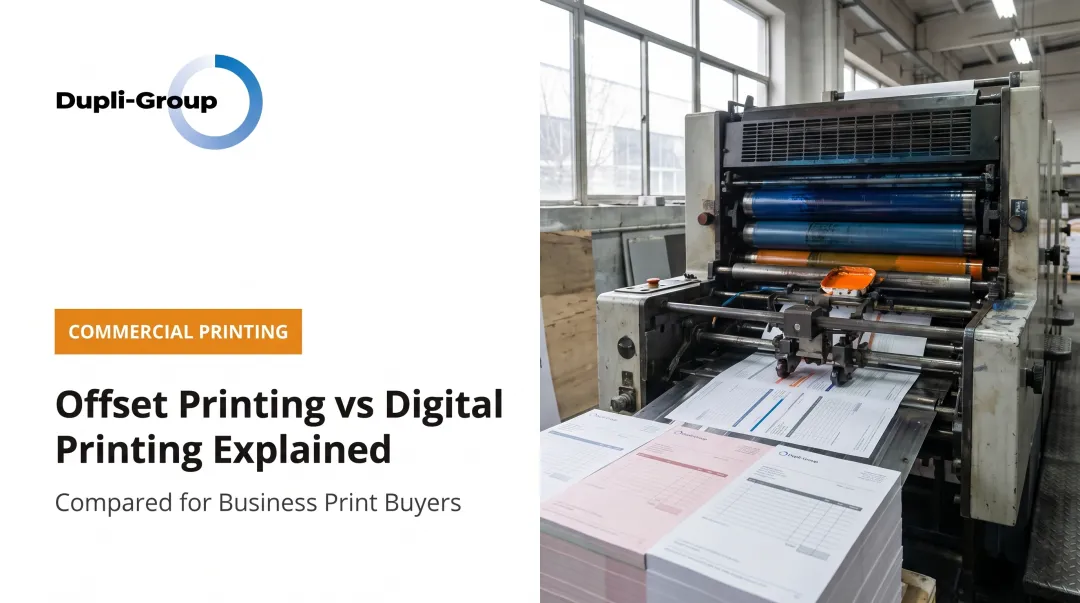
Offset printing uses plates and is built for large-volume, uniform runs. Per-unit cost drops as quantity increases, which makes it the better economic choice once you're printing well beyond a few hundred pieces.
Digital print flips that logic. There's no plate setup, which means faster turnaround and lower cost on smaller or personalized runs. HP's own comparison of digital versus offset confirms this: digital supports on-demand production without excess inventory, while offset is reserved for long, stable runs.
| Factor | Digital Printing | Offset Printing |
|---|---|---|
| Setup | No plates, minimal setup | Requires plate-making |
| Best for | Short runs, personalization | High-volume, uniform runs |
| Turnaround | Faster | Slower due to makeready |
| Personalization | Yes, via variable data (VDP) | Not practical |
Many full-service print partners offer both. Dupli-Group runs offset jobs on a KOMORI Lithrone press for larger quantities — generally anything above 250 business cards or 1,000 brochures — alongside digital presses for shorter runs and variable data work. That flexibility means businesses aren't locked into one method regardless of project size.
Conclusion
Digital print advertising works because it combines three things into one flexible workflow: digital file-based printing, per-piece personalization, and trackable distribution. Knowing that sequence helps you avoid underused personalization and poor vendor fit:
- File prep
- Press production
- Variable data
- Distribution
Choose a partner that can run short-run, personalized work reliably. Dupli-Group has served Chicago printers and businesses since 1945 and was an early HP Indigo adopter in Illinois—experience that shows up in sustainable, on-demand campaigns built for Chicagoland teams.
Frequently Asked Questions
How much does a print ad typically cost?
Costs vary based on run size, personalization level, and format. Digital print is generally more cost-effective for smaller, targeted runs, while offset becomes cheaper at higher volumes.
What is an ad print?
An "ad print" refers to a physical printed advertisement (a flyer, brochure, or direct mail piece) used to promote a product or service. It's distinct from digital-only ad formats like banner ads or social posts.
What are the key differences between commercial printing and digital printing?
Commercial (offset) printing uses plates and suits high-volume runs where per-unit costs drop at scale. Digital printing works directly from files, suits shorter runs, and enables personalization without extra setup costs.
Can digital print advertising materials be personalized for each recipient?
Yes. Variable data printing allows names, images, and offers to be customized per piece within the same print run, without slowing down production or requiring separate print jobs.
How long does it take to produce a digital print advertising campaign?
Digital print typically has a faster turnaround than offset since it skips plate-making entirely. That makes it a strong fit for time-sensitive campaigns needing quick delivery.
Is digital print advertising environmentally friendly?
It depends on the materials and inks used. Options like FSC-certified paper and soy-based inks (practices Dupli-Group adopted early, transitioning to 100% soy ink by 2005) can make campaigns more eco-conscious.