
Introduction
Picture a Chicago boutique owner planning a spring sale. She's got a digital ad budget mapped out, but her print rep just floated postcards and window clings. Which one actually moves foot traffic?
That question isn't going away. The global print advertising market is valued at $53.35 billion in 2025, according to The Business Research Company's market report. Print never left. It adapted.
People often confuse "advertising printing" with everyday commercial printing. This guide breaks down what it actually means, whether it still delivers results, and what to look for in a printing partner.
Throughout, we'll reference Dupli-Group, a nearly 80-year-old Chicago printing company, to show how a full-service advertising print partner operates in practice.
Key Takeaways
- Print advertising remains a $53.35 billion global market, adapting alongside digital rather than disappearing
- Direct mail drives 75% brand recall versus 44% for digital ads in controlled testing
- Short-run digital printing lets small businesses test campaigns without bulk minimums
- FSC and similar certifications increasingly shape how buyers judge brand credibility
- The right partner pairs modern press technology with mailing services under one roof
What Is Advertising Printing?
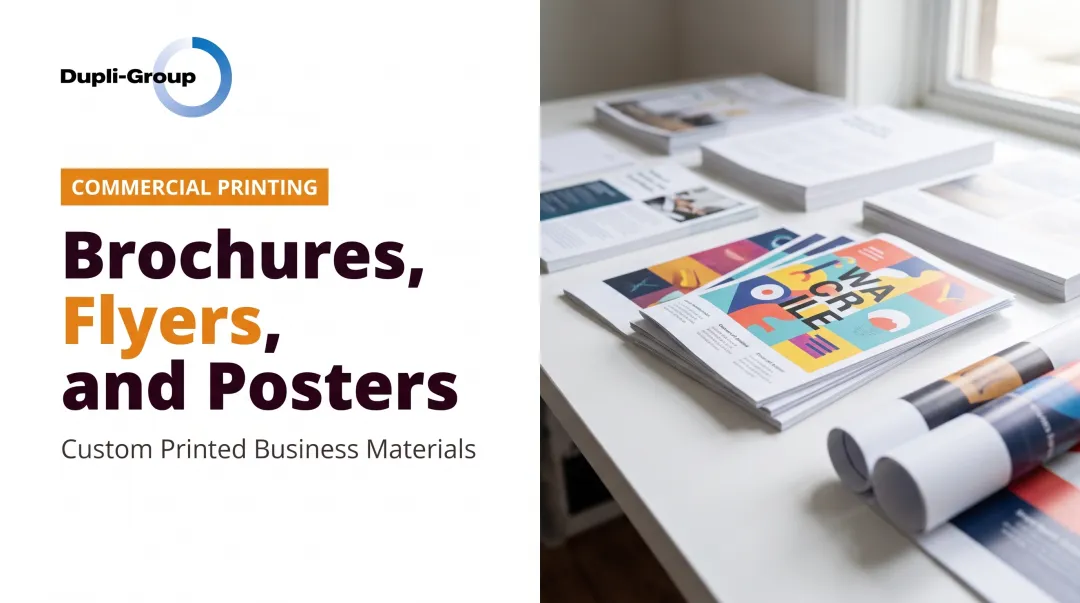
Advertising printing means producing physical marketing materials built to promote a product, service, or brand. Think flyers, brochures, direct mail pieces, posters, banners, and signage.
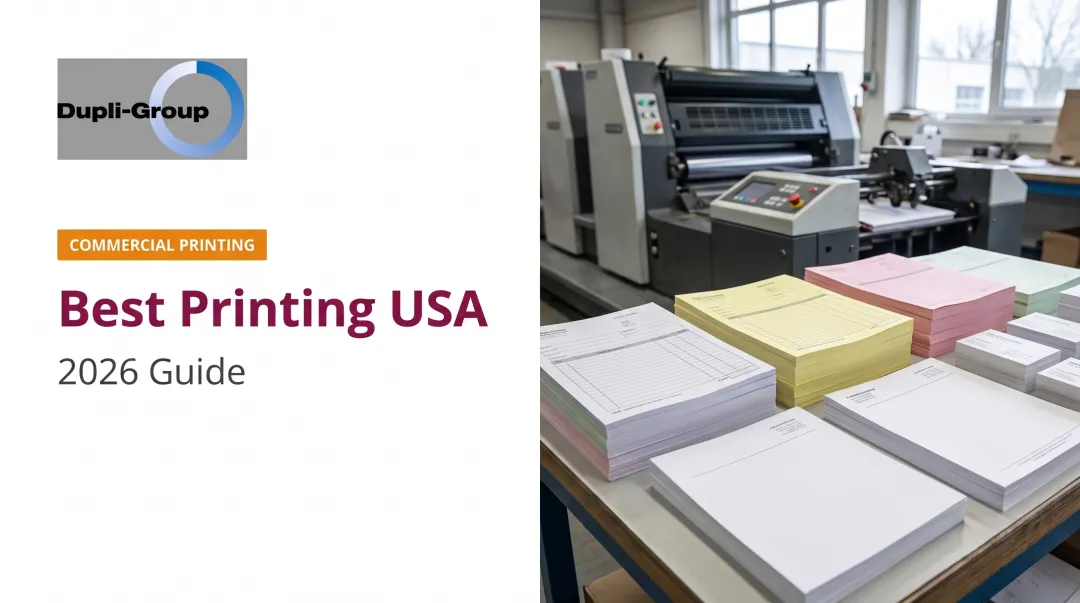
That's different from general commercial printing, which might just mean reproducing a document, a manual, or an internal report. Advertising printing has one job: persuade someone to act. Every design choice, from paper stock to fold style, gets filtered through that marketing intent.
The Bridge Between Design and Distribution
A graphic designer creates a concept. An advertising printing company turns that concept into something a customer can hold, hang, or open in their mailbox. Get the handoff wrong, and even strong design prints muddy, flimsy, or cheap.
- A file that looks perfect on screen can print muddy without proper color calibration
- Paper weight changes how a brochure feels in someone's hands, and feel affects perceived brand quality
- Finishing choices like lamination or die cutting can make a flyer look premium or cheap

From Offset Presses to On-Demand Digital
The industry has shifted gradually, not wholesale, from traditional offset printing toward digital, short-run production. WhatTheyThink's 2025 industry analysis points to shorter run lengths and rising demand for customization as the main drivers, while offset still wins on cost for large, standardized runs.
Dupli-Group's own history mirrors this shift. Founded in 1945 by Mac McCormack just after World War II, the company built its early reputation on traditional press work.
In the early 2000s, second-generation leader Wally McCormack moved the business into digital production, adopting one of the first HP Indigo presses in Illinois. That change let clients order short, personalized runs that offset presses simply weren't built for.
Are Print Ads Still Effective in the Digital Age?
The assumption that print is "dead" doesn't hold up against the data. Print didn't vanish. It found a new lane alongside digital.
Recall and Trust: The Numbers
A 2015 Canada Post neuroscience study, tested with EEG monitoring and eye tracking across 270 participants, found that direct mail generated 75% brand recall compared to 44% for digital ads. That's a 70% lift.
The same study found physical mail required 21% less cognitive effort to process and scored 20% higher on motivation to act. Your brain doesn't have to work as hard to remember a postcard as it does a banner ad you scrolled past three seconds ago.
Direct Mail Response Rates
Response benchmarks back this up. The ANA's 2023 Response Rate Report recorded a 15.6% response rate for house-file direct mail and 10.8% for prospect-file mail. Those figures came from a small survey sample, so treat them as a directional benchmark rather than a guarantee.
Print Works Best Paired With Digital
Print and digital outperform either channel alone when they work in sequence. Canada Post's sequencing research found that recall peaked when direct mail followed an email touchpoint, beating single-channel campaigns by 40%. Sequence matters as much as spend.

Sustainability Is Becoming a Trust Signal
Buyers now read sustainability credentials as a signal of brand integrity. Certifications such as FSC (Forest Stewardship Council) paper sourcing and soy-based inks carry real weight on a printed piece. Dupli-Group, for example, adopted FSC practices early and moved to 100% soy ink in 2005—proof points advertisers can put on the mailer itself, not only on a webpage.
Types of Print Advertising Services
Advertising printing is a toolkit. The right piece depends on your campaign goal—reach, response, or in-person impact.
Direct Mail Advertising
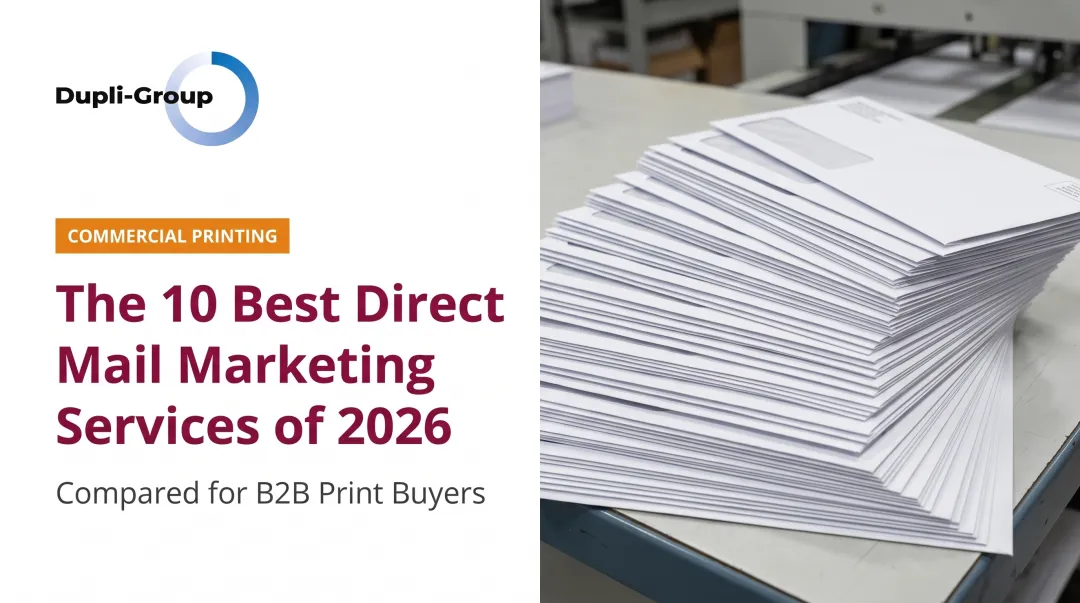
Postcards, catalogs, and mailers remain some of the most trackable advertising tools available. Variable data printing (VDP) takes it further, letting each piece in a run carry a different name, offer, or image without slowing production. A retailer can send 5,000 postcards where every single one addresses the recipient by name and shows a locally relevant offer.
Wide-Format Printing & Signage
Banners, posters, trade show displays, and storefront signage deliver high visibility for local and event-based campaigns. These formats work especially well when foot traffic, not scroll rate, is the goal—grand openings, sidewalk sales, or convention booths.
Short-Run & On-Demand Digital Printing
Digital presses like the HP Indigo remove the old barrier of high minimum order quantities. Businesses can print:
- A single test run of 50 flyers before committing to a full campaign
- Localized versions of the same ad for different neighborhoods
- Same-day rush jobs for time-sensitive promotions
This flexibility makes digital printing ideal for testing messaging before scaling up.
Brochures, Catalogs & Point-of-Sale Materials
When a customer is already in front of your product, print has to close the gap between interest and action. Common point-of-sale pieces include:
- Brochures and leave-behind catalogs that explain offers without a salesperson
- Tent cards that highlight promotions at the counter or table
- Window clings that pull walk-by traffic into the store
Used together, they keep branding consistent at the exact moment of decision—retail counters, lobbies, or trade show tables.
What to Look for in an Advertisers Printing Company
Not every printer can execute an advertising campaign well. Here's what separates a capable partner from a basic print shop.
- Modern digital press technology. Look for HP Indigo or comparable equipment that supports flexible, short-run orders without forcing you into large minimums.
- Environmental credentials. FSC certification and sustainable ink options matter to brand-conscious clients.
- Full-service capability. Printing, bindery, and mailing fulfillment under one roof simplifies logistics and cuts down on vendor handoffs.
- Proven longevity and local reputation. A printer with decades of community trust has typically weathered enough campaigns to know what actually works.
A quick note on cost: The U.S. Government Publishing Office's cost guidance flags these primary cost drivers:
- Finished size and paper stock
- Run quantity and color
- Turnaround time and finishing
Ask any printer for itemized quotes across these categories so you can compare vendors fairly.
Why Chicago Businesses Choose Dupli-Group for Advertising Printing
Founded in 1945 and still led by the McCormack family across two generations, Dupli-Group brings uncommon continuity to Chicago advertising print. That tenure shows up in the institutional knowledge behind every job—not just the equipment on the floor.
What Chicago businesses get in practice:
- One of the first HP Indigo presses in Illinois (early 2000s), so short-run and on-demand work can start at a single print
- FSC certification and a full switch to 100% soy-based inks in 2005, ahead of most regional competitors
- Digital printing, direct mail fulfillment (variable data and Every Door Direct Mail), and wide-format signage handled in-house
- A north-side Chicago shop near the CTA Lincoln/Addison station, embedded in the Chicagoland design community for decades

For teams weighing print against digital-only channels, that mix of flexible technology, sustainability credentials, and integrated in-house services covers what most advertising campaigns need.
Frequently Asked Questions
Are print ads still effective?
Yes. Industry studies often report higher brand recall for direct mail than for digital ads alone (figures around 75% vs. 44% appear in controlled comparisons). Print works best when paired with digital touchpoints, not used in isolation.
What are the types of print advertising?
The main categories are direct mail (postcards, mailers, catalogs), wide-format signage (banners, posters, trade show displays), and brochures or point-of-sale materials—often produced with short-run digital printing when you need flexible quantities.
What is advertising printing?
It's the production of physical marketing materials, such as flyers, brochures, mailers, and signage, specifically designed to promote a brand, product, or service rather than simply reproduce a document.
How much does print advertising typically cost?
Costs vary based on format, run size, paper stock, and finishing options. Digital short-run printing helps smaller campaigns avoid the high minimums that drive up per-piece costs on offset runs.
Is print advertising eco-friendly?
It can be. FSC-certified paper and soy-based inks reduce environmental impact compared with older print methods. Those choices also affect how many buyers judge a brand’s credibility.
How do I choose the right printing company for my ad campaign?
Prioritize modern digital press technology, verified sustainability credentials (such as FSC), and solid print-through-mail execution. A long-standing local reputation is a strong signal of consistent quality and reliable turnaround.