
U.S. printing shipments hit $7.41 billion in July 2025, up slightly from June, according to WhatTheyThink's industry tracking. That volume of activity means thousands of businesses are making this exact decision every month.
Picking the wrong method doesn't just cost money. It can slow down a campaign, waste paper, or leave your brand colors looking inconsistent across materials. This guide breaks down how offset and digital actually differ, where each one wins, and how to match the method to your project instead of guessing.
Key Takeaways
- Offset uses metal plates and delivers the lowest per-piece cost on large, high-volume runs
- Digital skips plates entirely, making it the fast, flexible choice for short runs and personalization
- Cost crossover isn't fixed: it shifts based on press type, coverage, and job specifics
- Sustainability options like soy ink and FSC-certified stock apply to both methods
- Volume, timeline, and personalization needs should drive your choice—not loyalty to one method
Offset vs Digital Printing: Quick Comparison
Here's how the two methods stack up across the factors that matter most to buyers:
| Factor | Offset Printing | Digital Printing |
|---|---|---|
| Setup cost | High (plates, calibration, makeready) | Minimal to none |
| Per-piece cost | Drops sharply at volume | Stays flat regardless of quantity |
| Color accuracy | Superior Pantone matching, solid areas | Strong overall, occasional banding on large solids |
| Turnaround | Longer: plate-making adds lead time | Fast, often same-day or next-day |
| Personalization | None—every piece is identical | Full variable data support |
| Sustainability | Wide range of eco stocks and finishes | Less material waste, pairs well with soy inks |
There's no universal quantity where offset suddenly becomes "the cheaper option." WhatTheyThink's analysis on crossover claims notes that press type, ink coverage, paper, and finishing all shift the math, which is exactly why job-specific quotes matter more than rules of thumb.
The consistent pattern: digital wins when setup time is your main constraint; offset wins once you're printing enough copies to absorb plate and makeready costs.

What Is Offset Printing?
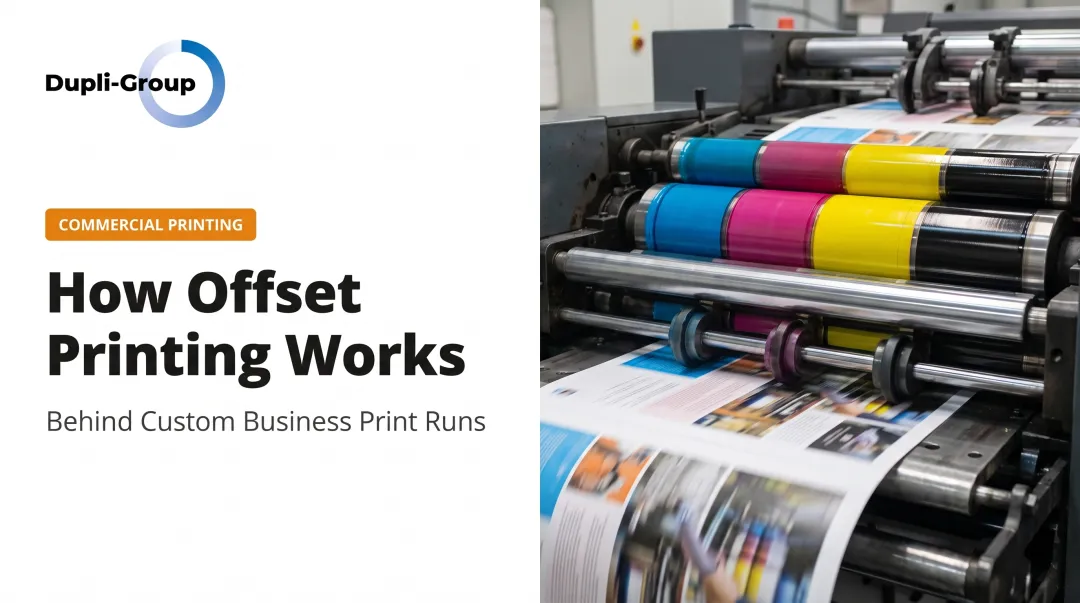
Offset printing transfers ink from a metal plate to a rubber blanket, then onto paper. That blanket step is what gives the process its name, and it's why offset delivers consistent, accurate color across thousands of sheets.
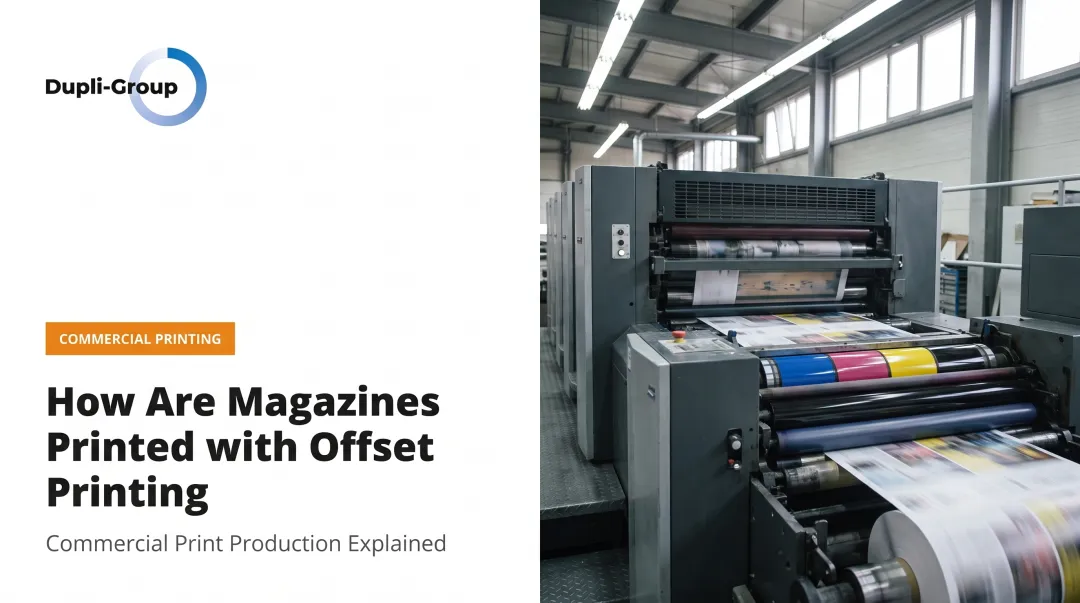
Dupli-Group runs this process on a KOMORI LITHRONE L528-C, a sheet-fed press built for 20×28 inch sheets. It handles Pantone inks beyond standard CMYK and includes an aqueous coater for gloss, dull, or satin finishes.
Why Businesses Still Choose Offset
Two benefits still make offset the better choice for many jobs:
- Color fidelity: Exact Pantone matching keeps brand colors identical from 500 folders to 50,000
- Lower per-piece cost at scale: Setup cost spreads across the run, so large catalogs often cost less per unit than digital
Offset presses generally come in two formats: sheet-fed, which feeds individual sheets and suits most commercial work, and web offset, which runs continuous rolls for very high-volume magazines or newspapers.
Dupli-Group's press is sheet-fed, which covers most business print needs without the cost of a web press.
Use Cases of Offset Printing
Offset fits naturally into large marketing production cycles: catalog runs, brochures, presentation folders, and newsletters where hundreds or thousands of identical pieces are needed.
Industries leaning on offset most heavily include:
- Retail catalogs and seasonal product guides
- Nonprofit organizations running large-scale mailers
- Book and menu printing, where print quality and paper feel matter
Offset has been a mainstay of Dupli-Group's work since the company was founded in 1945, and it remains how many Chicagoland businesses get high-volume catalog, brochure, and mailer runs done.
What Is Digital Printing?
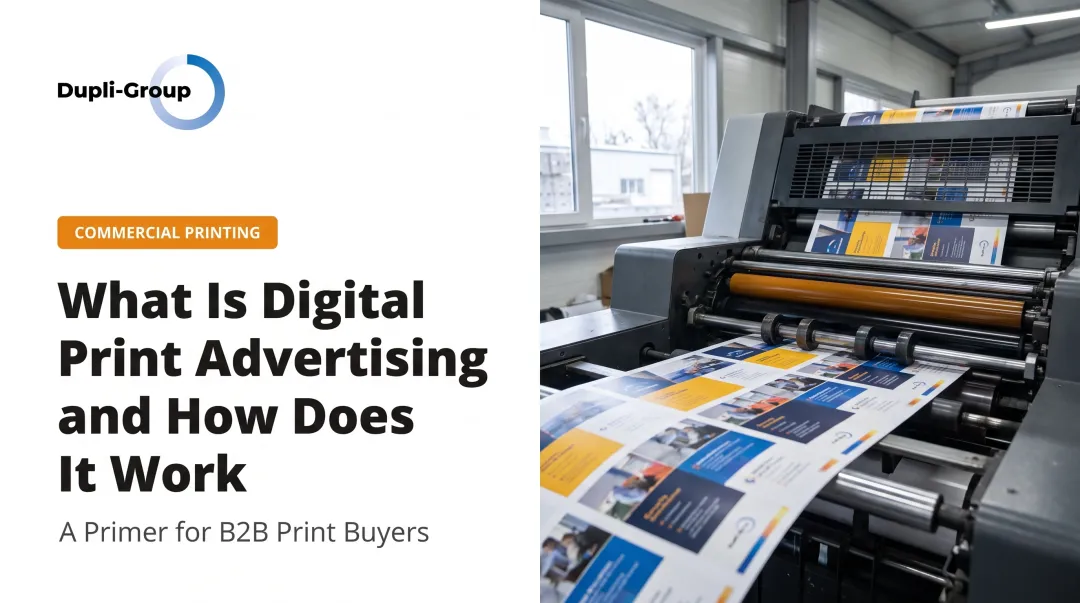
Digital printing skips plates entirely. Files go straight from a computer to press, so setup is nearly instant and every piece in a run can differ.
That plate-free process opens two doors offset can't:
- Variable data printing. Names, addresses, and even images can change from piece to piece in the same run, which helps direct mail campaigns lift response rates.
- On-demand, short-run capability. Businesses print exactly what they need, when they need it, without stockpiling excess inventory.
Toner vs. Inkjet Digital Presses
Digital presses generally fall into two camps. Toner-based (electrophotographic) presses fuse powdered particles onto paper with heat, producing sharp, fine detail. Inkjet presses deposit liquid ink droplets directly onto the substrate, often favored for smooth color blending in complex imagery, according to Fujifilm's technical comparison.
Dupli-Group was among the first companies in Illinois to adopt an HP Indigo press in the early 2000s, giving Chicago-area clients early access to flexible, short-run digital output. The company's current digital lineup also includes presses capable of 4-color process output up to 13×19 inches, with same-day turnaround possible.

Use Cases of Digital Printing
Digital printing is built for speed and flexibility. That suits businesses and marketers who update content often or work against tight deadlines.
Common digital-dominant projects include:
- Short-run business cards, letterheads, and stationery
- Personalized postcards and direct mail pieces
- Small-batch flyers, event programs, and tickets
Real-World Example: Choosing the Right Print Method
A Chicagoland nonprofit came to Dupli-Group facing a familiar problem: they needed a large annual-report catalog mailed to their full donor list, but they also wanted a personalized follow-up piece for their top-tier donors.
The challenge: a single method couldn't do both jobs well. A full digital run would have been costly at their catalog volume. A fully offset approach couldn't personalize the follow-up mailer.
The solution: Dupli-Group split the project.
- The bulk catalog ran on offset, keeping per-piece cost low across thousands of copies with full Pantone color accuracy.
- The donor follow-up used digital variable data printing, pulling names and giving amounts into each personalized letter.
- Both segments were fulfilled through Variable Data Mailing services backed by NCOA address verification.
Industry data backs the hybrid approach. Keypoint Intelligence's 2023 survey found that 97% of direct-mail users reported higher response rates with personalized mail, and 56% called the improvement significant.
The takeaway: when a project needs both volume and personalization, a hybrid offset-plus-digital strategy often beats choosing only one method.
Not sure which mix makes sense for your next project? Dupli-Group's team can walk through your volume, timeline, and personalization needs to map out the right approach.
Which Printing Method Is Right for You?
Before committing to either method, weigh these factors together, not in isolation:
- Print volume: Large, uniform runs favor offset; small or variable runs favor digital
- Budget: Digital avoids setup costs; offset rewards scale
- Timeline: Digital wins when turnaround is under a week
- Personalization: Any variable content requires digital
- Sustainability: Neither method blocks FSC-certified stock or soy-based inks
A simple rule of thumb: choose offset for large, uniform runs where premium color accuracy matters. Choose digital for short runs, tight deadlines, or personalized content. Consider a hybrid approach whenever a project needs both.

With nearly 80 years of offset experience, early HP Indigo adoption in Illinois, and FSC-certified soy-ink options, Dupli-Group helps Chicagoland businesses match the method to the job. Start with your volume, timeline, and need for variable content—those three usually settle the choice.
Frequently Asked Questions
Is offset printing better than digital?
Neither is universally better. Offset excels at large-volume, color-critical jobs, while digital wins on speed, short runs, and personalization. The right choice depends entirely on your project's specifics.
Which is cheaper, digital or offset printing?
Digital is cheaper at small quantities since there's no setup cost. Offset becomes more economical once volume climbs past a certain threshold, though that threshold varies by job.
What is digital printing and offset printing?
Offset transfers ink from a metal plate to a rubber blanket and then to paper. Digital printing sends files straight from computer to press with no plates involved.
How do I know if my project needs offset or digital printing?
Consider your quantity, personalization needs, turnaround time, and budget. A print partner offering both methods, like Dupli-Group, can recommend the best fit for your specific job.
Can offset and digital printing be combined in one project?
Yes. A common hybrid approach uses offset for the bulk print run and digital for personalized inserts or targeted follow-up mailers, giving you both cost efficiency and customization.
Is digital printing as high-quality as offset today?
Modern digital presses have closed much of the gap, but offset still leads for large solid color areas, exact Pantone matching, and specialty finishes on premium jobs.