
The global offset-litho market was valued at $354.4 billion in 2019, and even with a projected 2.5% annual decline, Smithers forecasts it will still be worth $307.9 billion by 2029. That's not a shrinking niche — that's a mature, massive industry.
Many businesses order offset print jobs regularly without understanding the plate-to-blanket-to-paper mechanics behind them. That gap leads to poor print specification choices and unrealistic turnaround expectations. This guide breaks down exactly how offset printing works, step by step.
TL;DR
- Offset printing transfers ink from a plate to a rubber blanket, then onto paper — never directly plate-to-paper
- The process relies on oil and water repulsion for sharp, consistent image reproduction
- Production moves through four stages: plate setup, inking and transfer, dampening control, and drying/delivery
- Best suited for large-volume, color-consistent jobs like business forms, catalogs, and marketing materials
- Stays the high-volume standard thanks to cost efficiency and color accuracy at scale
What Is Offset Printing?
Offset printing, also called offset lithography, is a printing method where an inked image transfers from a plate to a rubber blanket, then onto the printing surface. It's a planographic process, meaning the image and non-image areas sit on the same flat plane of the plate rather than being raised or recessed.
The entire method hinges on one principle: oil and water don't mix. According to the U.S. EPA's technical guidance on lithographic printing, image areas on the plate are oil-receptive, while non-image areas are water-receptive. A water-based fountain solution keeps ink away from areas that shouldn't print, so only the intended image picks up ink.
Why does this indirect transfer matter? Earlier direct-to-surface methods like letterpress pressed a raised, inked surface straight onto paper. That approach wore down printing surfaces faster and struggled with fine detail. Offset's indirect plate-to-blanket-to-paper path solved both problems, preserving image sharpness across long runs.
Offset is not digital printing. There's no file sent straight to toner or inkjet heads. Every color requires its own physical plate, and offset can't handle variable data, meaning no personalization within a single run.
Two main variants exist:
- Wet offset — uses a dampening fluid to control the ink/water balance on the plate
- Waterless offset — uses silicone-coated plates that repel ink without fountain solution; Toray notes presses reach color faster with no ink/water balance to dial in

How Does Offset Printing Work?
Offset printing moves through a defined sequence: digital file, plate, ink transfer, and final printed sheet. Each stage shapes the final print quality, and a weak link anywhere in the chain shows up on the finished product.
Prepress and Plate-Making
Every job starts in prepress. Prepress converts digital files into the CMYK color model and separates them into individual color plates, one plate per ink color.
Plate creation today runs almost entirely through computer-to-plate (CTP) imaging, replacing older film-based methods. Two common CTP approaches exist:
- Thermal imaging systems, which expose plates using an 830-nanometer laser (as specified in Kodak's Trendsetter platesetter documentation)
- Violet photopolymer systems, which use a 405-nanometer diode to begin polymerizing image areas before a clean-out unit removes the unexposed coating
Plate imaging and press calibration are fixed, job-level costs. They don't scale with quantity. That is why offset becomes cost-effective at higher volumes: the setup expense spreads across more units, while run costs (impressions, paper, waste) rise with quantity.
Inking and Blanket Transfer
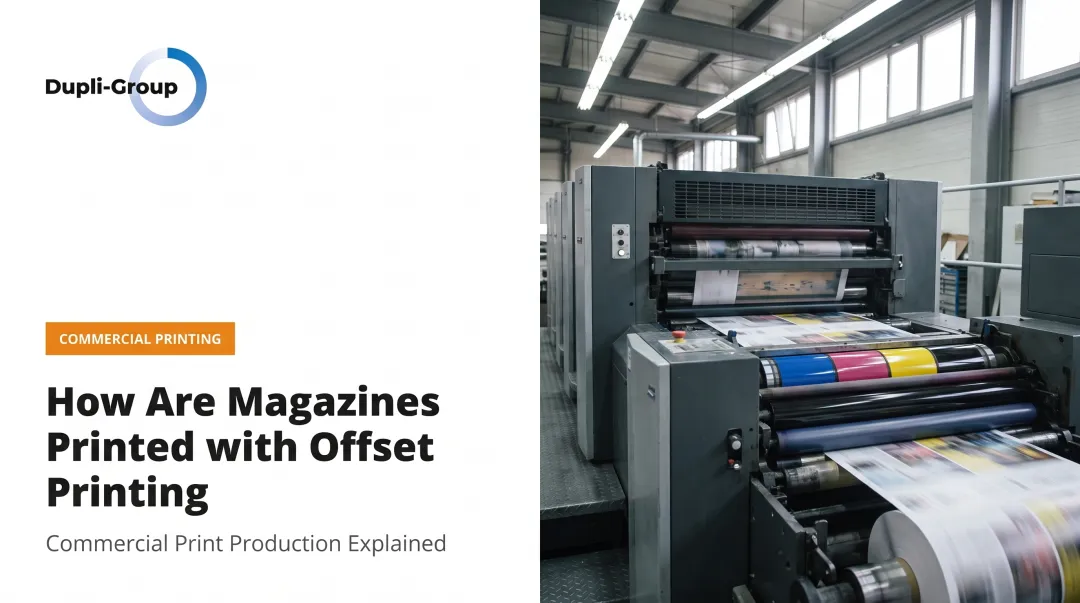
Once plates are mounted, the press gets to work. Ink rollers apply ink to the image areas of the plate. Water rollers simultaneously keep non-image areas ink-free, using the repulsion between oil-based ink and water.
The inked image never touches paper directly. Instead:
- The plate cylinder transfers the inked image onto a rubber blanket cylinder
- The blanket cylinder presses that image onto the paper or substrate
- The blanket's slight give conforms to paper texture, improving detail and consistency
This blanket step is why offset plates can last through extremely long runs without losing image quality: the blanket absorbs the physical wear, not the plate itself.
Dampening and Ink Balance
Consistency across thousands of sheets doesn't happen automatically. Operators actively manage the dampening solution (or the silicone layer in waterless systems) that governs how ink adheres to the plate.
Modern presses use electronically controlled ink duct systems to fine-tune density in real time. Heidelberg's sheetfed press documentation, for example, describes ink fountains that meter each color zone in 500 separate increments. That is the level of control operators work with on press.
Get the ink/water ratio wrong, and you'll see it fast:
- Slur: directional smearing from differences in cylinder surface speed
- Streaking: often traced to overly hard ink or dampening rollers
- Doubling: a register problem within the printing unit itself
These faults directly affect first-pass acceptance rates, which is why press operators watch density readings throughout a run rather than just at startup.
Drying and Delivery
Printed sheets or web-fed rolls go to delivery and drying. The method depends on press type and stock.
- Heatset drying: used for coated, glossy stock on web presses. The EPA notes that roughly 80% of petroleum ink oil volatilizes and gets exhausted through the dryer
- Coldset/absorption drying: used for uncoated stock like newsprint, where ink oils absorb into the substrate rather than evaporating
Drying behavior also depends on ink chemistry. Vegetable-based inks made from soybean, rapeseed, or rice-bran oils cut VOC emissions while performing comparably to mineral-oil inks. Dupli-Group made this switch early, moving to 100% soy ink usage by 2005 under second-generation leader Wally McCormack.
Properly dried, correctly registered sheets move straight into finishing: cutting, folding, binding. Steady drying calibration keeps that handoff clean and limits rework.

Where Is Offset Printing Used?
Offset is the production method of choice for high-volume commercial work across several categories:
- Publishing (magazines, books, catalogs)
- Packaging
- Direct mail pieces
- Marketing collateral requiring precise color matching
In the print workflow, it sits after design and prepress approval and before bindery and finishing. It performs best on long runs, jobs that need custom Pantone or metallic inks, and projects that call for a wide range of paper stocks and finishes.
Dupli-Group's production floor shows that range in practice. Its Komori Lithrone L528-C offset press handles 20x28-inch sheets, runs Pantone and spot colors beyond standard CMYK, and applies aqueous coating for gloss, dull, or satin finishes.
That setup suits brochures, annual reports, and similar commercial work. A smaller two-color press covers more modest jobs like stationery and postcards.
Choosing between offset and digital comes down to run length and customization needs. A shop with decades of offset heritage plus digital and direct mail capability, like Dupli-Group in Chicago, can match the method to the job instead of defaulting to one process.
Conclusion
Offset printing works because of an indirect transfer: plate to blanket to paper, governed by the simple fact that oil and water don't mix. Refined with prepress automation, tight ink control, and the right drying method, that same mechanism is how shops hit volume, consistency, and accurate color at scale.
Once you know the mechanics, a print quote is easier to read. Turnaround times, cost breakpoints, and run-length tradeoffs stop looking arbitrary — and you can tell when offset, not digital, is the smarter call for the job.
Frequently Asked Questions
Is offset printing cheaper?
Offset carries higher upfront costs for plates and press calibration, but the per-unit cost drops significantly as volume increases. Digital printing usually wins for small quantities; offset wins at scale.
What does offset printing mean?
The term "offset" refers to the fact that ink never touches paper directly. It's transferred, or offset, from a plate to a rubber blanket first, then onto the substrate.
What is the difference between offset and digital printing?
Offset uses physical plates and a blanket to transfer ink. Digital printing sends files straight to toner or inkjet heads with no plates, allowing variable data and faster turnaround on smaller runs.
Is offset printing high quality?
Yes. Offset delivers strong color accuracy, sharp detail, and consistency across thousands of impressions, especially valuable for custom Pantone colors and long production runs.
What is offset printing used for?
Magazines, books, newspapers, packaging, brochures, and marketing materials that need large volumes and precise, repeatable color matching all rely on offset.
Is offset printing environmentally friendly?
Traditional offset relied on solvent-based inks, but many shops now use soy-based inks and FSC-certified paper stocks. Dupli-Group, for instance, moved to 100% soy ink usage back in 2005.